

There is a certain kind of person who cannot accept that a car can just be driven. They need to open its hood to understand how it works. I am one of these people, so I just had to find out how coroutines work. If you're like this too, you will enjoy this chapter. If not, you can just skip it.
This chapter won't introduce any new tools that you might use. It is purely explanatory. It tries to explain to a satisfactory level how coroutines work. The key lessons are:
- Suspending functions are like state machines, with a possible state at the beginning of the function and after each suspending function call.
- Both the number identifying the state and references to the local variables are stored in the continuation object before suspending functions are called.
- Continuation of a function decorates a continuation of its caller function; as a result, all these continuations represent a call stack that is used when we resume or a resumed function completes.
- When a suspending function is resumed, it first calls its function; once this is done, it resumes the continuation of the function that called this function. This continuation calls its function, and the process repeats until the top of the stack is reached.
If you are interested in learning internals (simplified, of course), read on, if not, you can skip this chapter.
There are a few ways in which suspending functions could have been implemented, but the Kotlin team decided on an option called continuation-passing style. This means that continuations (explained in the previous chapter) are passed from function to function as arguments. By convention, a continuation takes the last parameter position.
suspend fun getUser(): User?
suspend fun setUser(user: User)
suspend fun checkAvailability(flight: Flight): Boolean

// under the hood is
fun getUser(continuation: Continuation<*>): Any?
fun setUser(user: User, continuation: Continuation<*>): Any
fun checkAvailability(
  flight: Flight,
  continuation: Continuation<*>
): Any
You might have also noticed that the result type under the hood is different from the originally declared one. It has changed to
Any or Any?. Why so? The reason is that a suspending function might be suspended, and so it might not return a declared type. In such a case, it returns a special COROUTINE_SUSPENDED marker, which we will later see in practice. For now, just notice that since getUser might return User? or COROUTINE_SUSPENDED (which is of type Any), its result type must be the closest supertype of User? and Any, so it is Any?. Perhaps one day Kotlin will introduce union types, in which case we will have User? | COROUTINE_SUSPENDED instead.To dive deeper, let's start with a very simple function that prints something before and after a delay.
suspend fun myFunction() {
  println("Before")
  delay(1000) // suspending
  println("After")
}
You can already deduce how the
myFunction function signature will look under the hood:fun myFunction(continuation: Continuation<*>): Any
The next thing is that this function needs its own continuation in order to remember its state. Let's name it
MyFunctionContinuation (the actual continuation is an object expression and has no name, but it will be easier to explain this way). At the beginning of its body, myFunction will wrap the continuation (the parameter) with its own continuation (MyFunctionContinuation).val continuation = MyFunctionContinuation(continuation)
This should be done only if the continuation isn't wrapped already. If it is, this is part of the resume process, and we should keep the continuation unchanged[^104_1] (this might be confusing now, but later you will better see why).
val continuation =
  if (continuation is MyFunctionContinuation) continuation
  else MyFunctionContinuation(continuation)
This condition can be simplified to:
val continuation = continuation as? MyFunctionContinuation
  ?: MyFunctionContinuation(continuation)
Finally, let's talk about the body of our function.
suspend fun myFunction() {
  println("Before")
  delay(1000) // suspending
  println("After")
}
The function could be started from two places: either from the beginning (in the case of a first call) or from the point after suspension (in the case of resuming from continuation). To identify the current state, we use a field called
label. At the start, it is 0, therefore the function will start from the beginning. However, it is set to the next state before each suspension point so that we start from just after the suspension point after a resume.// A simplified picture of how myFunction looks under the hood fun myFunction(continuation: Continuation<Unit>): Any { val continuation = continuation as? MyFunctionContinuation ?: MyFunctionContinuation(continuation) if (continuation.label == 0) { println("Before") continuation.label = 1 if (delay(1000, continuation) == COROUTINE_SUSPENDED){ return COROUTINE_SUSPENDED } } if (continuation.label == 1) { println("After") return Unit } error("Impossible") }
The last important piece is also presented in the snippet above. When
delay is suspended, it returns COROUTINE_SUSPENDED, then myFunction returns COROUTINE_SUSPENDED; the same is done by the function that called it, and the function that called this function, and all other functions until the top of the call stack[^104_4]. This is how a suspension ends all these functions and leaves the thread available for other runnables (including coroutines) to be used.Before we go any further, let's analyze the code above. What would happen if this
delay call didn't return COROUTINE_SUSPENDED? What if it just returned Unit instead (we know it won't, but let's hypothesize)? Notice that if the delay just returned Unit, we would just move to the next state, and the function would behave like any other.Now, let's talk about the continuation, which is implemented as an anonymous class. Simplified, it looks like this:
cont = object : ContinuationImpl(continuation) {
    var result: Any? = null
    var label = 0

    override fun invokeSuspend(`$result$: Any?): Any? {
        this.result = $result`;
        return myFunction(this);
    }
};
To improve the readability of our function, I decided to represent it as a class named
MyFunctionContinuation. I also decided to hide the inheritance by inlining the ContinuationImpl body. The resulting class is simplified: I've skipped many optimizations and functionalities so as to keep only what is essential.In JVM, type arguments are erased during compilation; so, for instance, bothContinuation<Unit>orContinuation<String>become justContinuation. Since everything we present here is Kotlin representation of JVM bytecode, you should not worry about these type arguments at all.
The code below presents a complete simplification of how our function looks under the hood:
import java.util.concurrent.Executors
import java.util.concurrent.TimeUnit
import kotlin.coroutines.Continuation
import kotlin.coroutines.CoroutineContext
import kotlin.coroutines.EmptyCoroutineContext
import kotlin.coroutines.resume

//sampleStart
fun myFunction(continuation: Continuation<Unit>): Any {
    val continuation = continuation as? MyFunctionContinuation
        ?: MyFunctionContinuation(continuation)

    if (continuation.label == 0) {
        println("Before")
        continuation.label = 1
        if (delay(1000, continuation) == COROUTINE_SUSPENDED){
            return COROUTINE_SUSPENDED
        }
    }
    if (continuation.label == 1) {
        println("After")
        return Unit
    }
    error("Impossible")
}

class MyFunctionContinuation(
    val completion: Continuation<Unit>
) : Continuation<Unit> {
    override val context: CoroutineContext
        get() = completion.context

    var label = 0
    var result: Result<Any>? = null

    override fun resumeWith(result: Result<Unit>) {
        this.result = result
        val res = try {
            val r = myFunction(this)
            if (r == COROUTINE_SUSPENDED) return
            Result.success(r as Unit)
        } catch (e: Throwable) {
            Result.failure(e)
        }
        completion.resumeWith(res)
    }
}
//sampleEnd

private val executor = Executors
    .newSingleThreadScheduledExecutor {
        Thread(it, "scheduler").apply { isDaemon = true }
    }

fun delay(timeMillis: Long, continuation: Continuation<Unit>): Any {
    executor.schedule({
        continuation.resume(Unit)
    }, timeMillis, TimeUnit.MILLISECONDS)
    return COROUTINE_SUSPENDED
}

fun main() {
    val EMPTY_CONTINUATION = object : Continuation<Unit> {
        override val context: CoroutineContext =
            EmptyCoroutineContext

        override fun resumeWith(result: Result<Unit>) {
            // This is root coroutine, we don't need anything in this example
        }
    }
    myFunction(EMPTY_CONTINUATION)
    Thread.sleep(2000)
    // Needed to don't let the main finish immediately.
}

val COROUTINE_SUSPENDED = Any()
If you want to analyze by yourself what suspending functions are under the hood, open the function in IntelliJ IDEA, use Tools > Kotlin > Show Kotlin bytecode, and click the "Decompile" button. As a result, you will see this code decompiled to Java (so more or less how this code would look if it were written in Java).
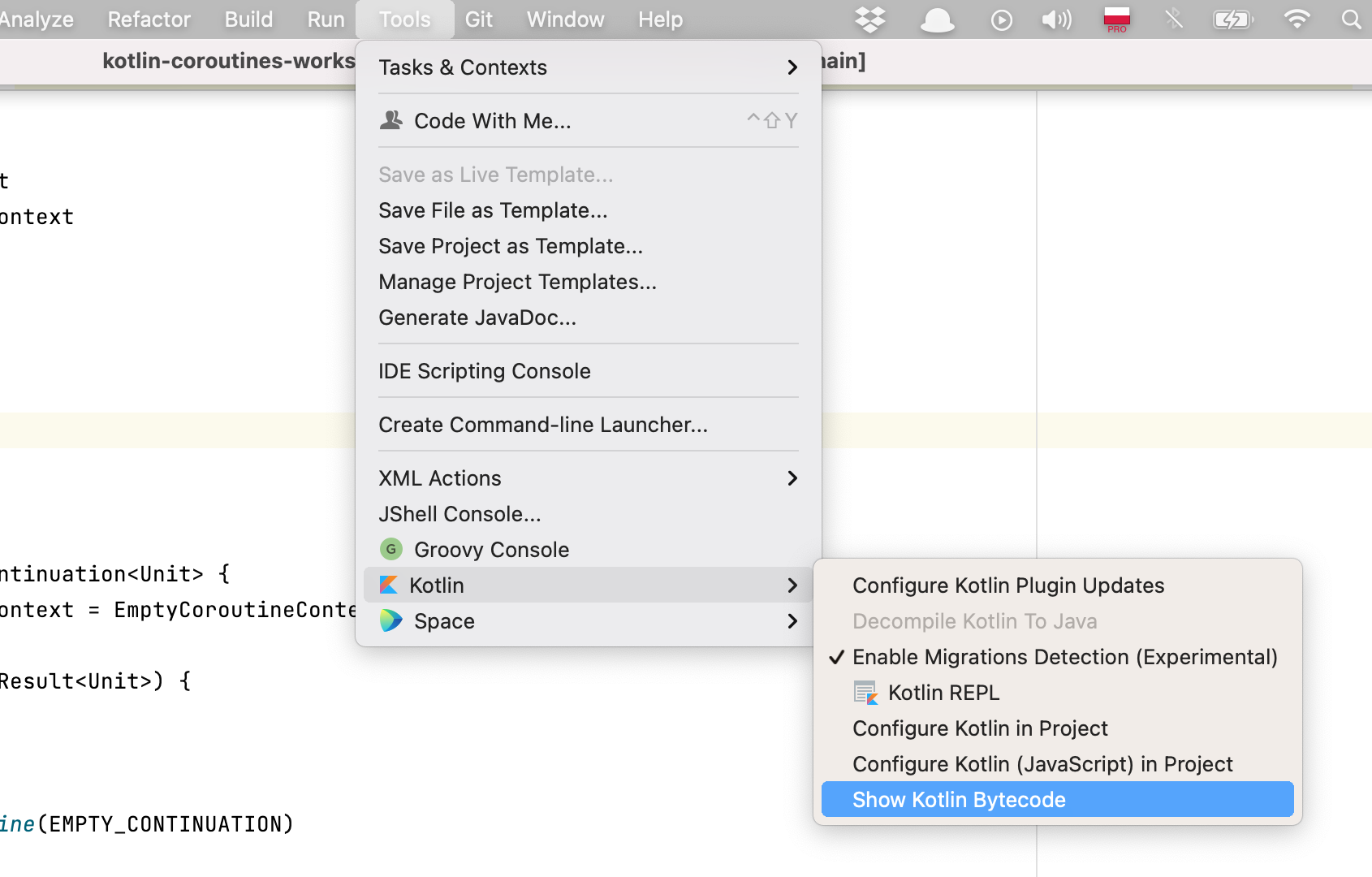
How to show the bytecode generated from the file.
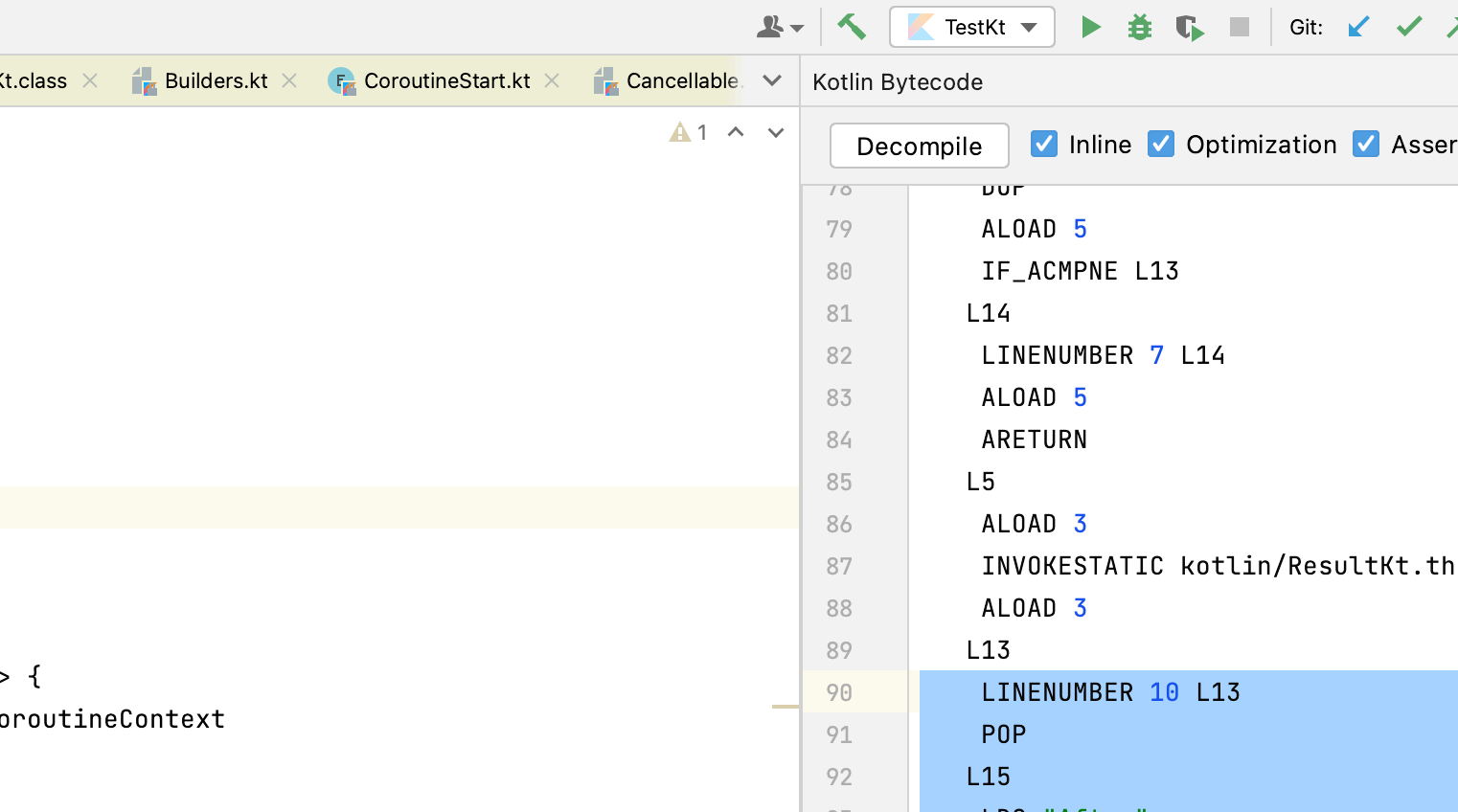
The bytecode generated from the file. Notice the "Decompile" button, which lets us decompile this bytecode to Java.
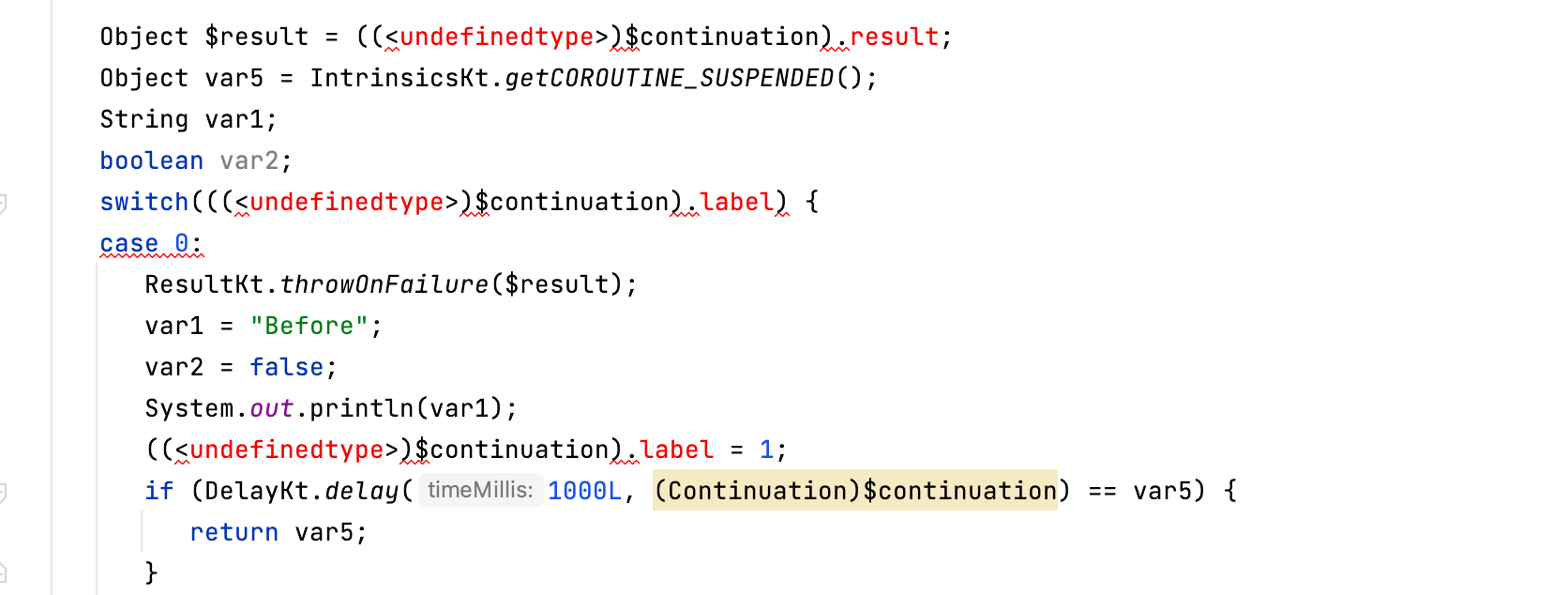
Bytecode from the Kotlin suspending function decompiled into Java.
When a function is resumed, it needs to restore not only the position where it was suspended, but also its state, like local variables or parameters. So what would have changed if we added a local variable to our function, that is defined before suspension and used after it[^104_5]? The answer is simple: this variable would need to be referenced in the continuation before suspension and restored after it. Let's consider the following function:
suspend fun myFunction(surname: String) {
  println("Before")
  var name = "John"
  delay(1000) // suspending
  println("His name is: $name $surname")
  println("After")
}
Here
name is needed in two states (for a label equal to 0 and 1), so it needs to be kept in the continuation. It will be stored right before suspension. Restoring these kinds of properties happens at the beginning of the function. Parameter surname also needs to be stored in the continuation, but since it is a parameter, it is referenced when continuation is created, and used when the function is resumed. So, this is how the (simplified) function looks under the hood:import java.util.concurrent.Executors import java.util.concurrent.TimeUnit import kotlin.coroutines.* //sampleStart fun myFunction(surname: String, continuation: Continuation<Unit>): Any { val continuation = continuation as? MyFunctionContinuation ?: MyFunctionContinuation(surname, continuation) var name = continuation.name if (continuation.label == 0) { println("Before") name = "John" continuation.name = name continuation.label = 1 if (delay(1000, continuation) == COROUTINE_SUSPENDED){ return COROUTINE_SUSPENDED } } if (continuation.label == 1) { println("His name is: $name") println("After") return Unit } error("Impossible") } class MyFunctionContinuation( val surname: String, val completion: Continuation<Unit> ) : Continuation<Unit> { override val context: CoroutineContext get() = completion.context var result: Result<Unit>? = null var label = 0 var name: String? = null override fun resumeWith(result: Result<Unit>) { this.result = result val res = try { val r = myFunction(surname, this) if (r == COROUTINE_SUSPENDED) return Result.success(r as Unit) } catch (e: Throwable) { Result.failure(e) } completion.resumeWith(res) } } //sampleEnd private val executor = Executors.newSingleThreadScheduledExecutor { Thread(it, "scheduler").apply { isDaemon = true } } fun delay(timeMillis: Long, continuation: Continuation<Unit>): Any { executor.schedule({ continuation.resume(Unit) }, timeMillis, TimeUnit.MILLISECONDS) return COROUTINE_SUSPENDED } fun main() { val EMPTY_CONTINUATION = object : Continuation<Unit> { override val context: CoroutineContext = EmptyCoroutineContext override fun resumeWith(result: Result<Unit>) { // This is root coroutine, we don't need anything in this example } } myFunction(EMPTY_CONTINUATION) Thread.sleep(2000) // Needed to prevent main() from finishing immediately. } private val COROUTINE_SUSPENDED = Any()
Notice that continuations only reference existing objects; they do not copy them. This operation is cheap. The biggest cost of calling a suspending function is a creation of a continuation object, which is a lightweight object, but still an object.
The situation is slightly different if we actually expect some data from the suspension. Let's analyze the function below:
suspend fun printUser(token: String) {
  println("Before")
  val userId = getUserId(token) // suspending
  println("Got userId: $userId")
  val userName = getUserName(userId, token) // suspending
  println(User(userId, userName))
  println("After")
}
Here there are two suspending functions:
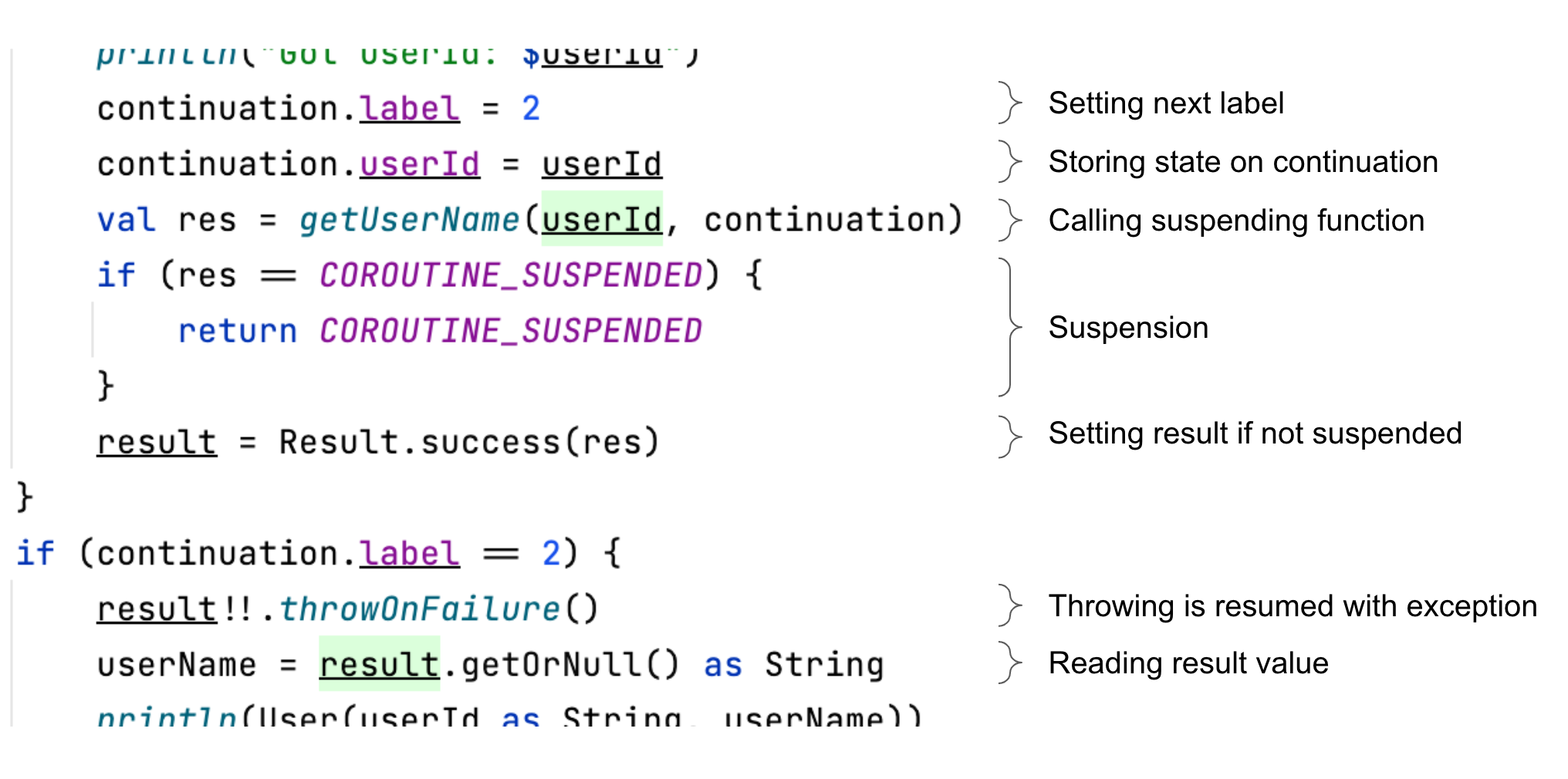
getUserId and getUserName. We also added a parameter token, and our suspending function also returns some values. This all needs to be stored in the continuation:token, that is necessary to callgetUserName,userId, because it is necessary in states 1 and 2,resultof typeResult, which represents how this function was resumed.
If the function was resumed with a value, the result will be
Result.Success(value). In such a case, we can get and use this value. If it was resumed with an exception, the result will be Result.Failure(exception). In such a case, this exception will be thrown.import java.util.concurrent.Executors import java.util.concurrent.TimeUnit import kotlin.coroutines.* //sampleStart fun printUser( token: String, continuation: Continuation<*> ): Any { val continuation = continuation as? PrintUserContinuation ?: PrintUserContinuation( continuation as Continuation<Unit>, token ) var result: Result<Any>? = continuation.result var userId: String? = continuation.userId val userName: String if (continuation.label == 0) { println("Before") continuation.label = 1 val res = getUserId(token, continuation) if (res == COROUTINE_SUSPENDED) { return COROUTINE_SUSPENDED } result = Result.success(res) } if (continuation.label == 1) { userId = result!!.getOrThrow() as String println("Got userId: $userId") continuation.label = 2 continuation.userId = userId val res = getUserName(userId, continuation) if (res == COROUTINE_SUSPENDED) { return COROUTINE_SUSPENDED } result = Result.success(res) } if (continuation.label == 2) { userName = result!!.getOrThrow() as String println(User(userId as String, userName)) println("After") return Unit } error("Impossible") } class PrintUserContinuation( val completion: Continuation<Unit>, val token: String ) : Continuation<String> { override val context: CoroutineContext get() = completion.context var label = 0 var result: Result<Any>? = null var userId: String? = null override fun resumeWith(result: Result<String>) { this.result = result val res = try { val r = printUser(token, this) if (r == COROUTINE_SUSPENDED) return Result.success(r as Unit) } catch (e: Throwable) { Result.failure(e) } completion.resumeWith(res) } } //sampleEnd fun main() { toStart() } private val executor = Executors.newSingleThreadScheduledExecutor { Thread(it, "scheduler").apply { isDaemon = true } } data class User(val id: String, val name: String) object ApiException : Throwable("Fake API exception") fun getUserId(token: String, continuation: Continuation<String>): Any { executor.schedule({ continuation.resume("SomeId") }, 1000, TimeUnit.MILLISECONDS) return COROUTINE_SUSPENDED } fun getUserName(userId: String, continuation: Continuation<String>): Any { executor.schedule({ continuation.resume("SomeName") // continuation.resumeWithException(ApiException) }, 1000, TimeUnit.MILLISECONDS) return COROUTINE_SUSPENDED } fun toStart() { val EMPTY_CONTINUATION = object : Continuation<Unit> { override val context: CoroutineContext = EmptyCoroutineContext override fun resumeWith(result: kotlin.Result<Unit>) { if (result.isFailure) { result.exceptionOrNull()?.printStackTrace() } } } printUser("SomeToken", EMPTY_CONTINUATION) Thread.sleep(3000) // Needed to prevent the function from finishing immediately. } private fun Result<*>.throwOnFailure() { if (isFailure) throw exceptionOrNull()!! } private val COROUTINE_SUSPENDED = Any()
When function
a calls function b, the virtual machine needs to store the state of a somewhere, as well as the address where execution should return once b is finished. All this is stored in a structure called call stack[^104_2]. The problem is that when we suspend, we free a thread; as a result, we clear our call stack. Therefore, the call stack is not useful when we resume. Instead, the continuations serve as a call stack. Each continuation keeps the state where we suspended (as a label) the function's local variables and parameters (as fields), and the reference to the continuation of the function that called this function. One continuation references another, which references another, etc. As a result, our continuation is like a huge onion: it keeps everything that is generally kept on the call stack. Take a look at the following example:suspend fun a() { val user = readUser() b() b() b() println(user) } suspend fun b() { for (i in 1..10) { c(i) } } suspend fun c(i: Int) { delay(i * 100L) println("Tick") }
A sample continuation could be represented as follows:
CContinuation(
 i = 4,
 label = 1,
 completion = BContinuation(
     i = 4,
     label = 1,
     completion = AContinuation(
         label = 2,
         user = User@1234,
         completion = ...
     )
 )
)
Looking at the above representation, how many times was "Tick" already printed (assumereadUseris not a suspending function)[^104_3]?
When a continuation is resumed, each continuation first calls its function; once this is done, that continuation resumes the continuation of the function that called the function. This continuation calls its function, and the process repeats until the top of the stack is reached.
override fun resumeWith(result: Result<String>) {
    this.result = result
    val res = try {
        val r = printUser(token, this)
        if (r == COROUTINE_SUSPENDED) return
        Result.success(r as Unit)
    } catch (e: Throwable) {
        Result.failure(e)
    }
    completion.resumeWith(res)
}
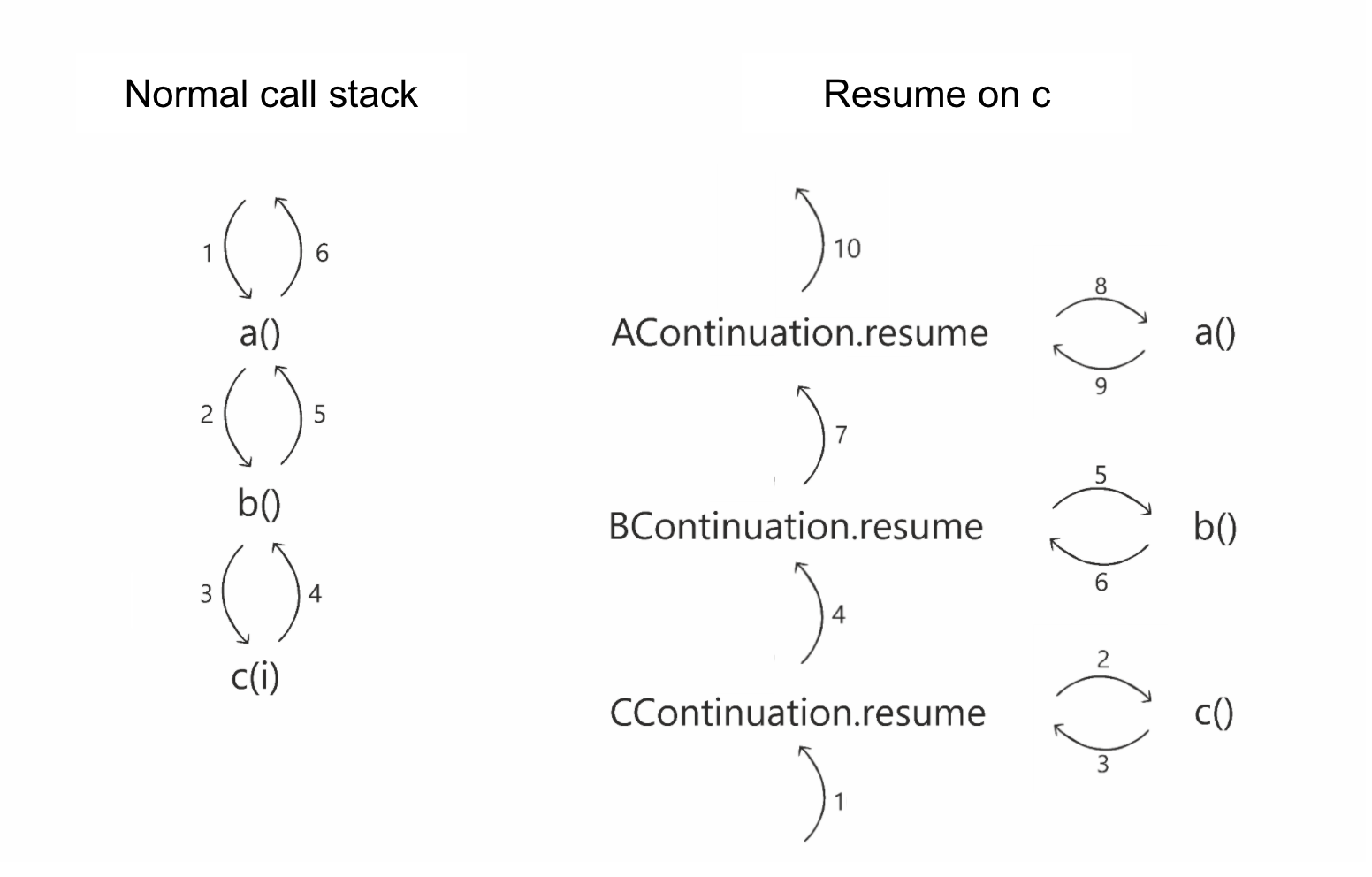
For example, think of a situation where function
a calls function b, which calls function c, which is suspended. During resuming, the c continuation first resumes the c function. Once this function is done, the c continuation resumes the b continuation that calls the b function. Once it is done, the b continuation resumes the a continuation, which calls the a function.The whole process can be visualized with the following sketch:
It's similar with exceptions: an uncaught exception is caught in
resumeWith and then wrapped with Result.failure(e), and then the function that called our function is resumed with this result.I hope this all gives you some picture of what is going on when we suspend. The state needs to be stored in a continuation, and the suspension mechanism needs to be supported. When we resume, we need to restore the state from the continuation and either use the result or throw an exception.
Everything what was said already applies to suspending functions defined as class members. The only difference is that the continuation must also store a reference to the object that the function is a member of. This is needed to call the function on the correct object when resuming.
class UserRepository {
    suspend fun getUser(id: String): User {
        // UserRepository is stored in the continuation
        return getUserFromApi(id)
    }

    // ...
}
If suspending function is an extension function, extension receiver is treated like any other parameter (it actually is just a parameter under the hood), so it is stored in the continuation as well.
A function in Kotlin might have more receivers, for instance, a member extension function, or a function inside an inline class, have two receivers. That is not a problem, they are both stored implicitly in the continuation.
The actual code that continuations and suspending functions are compiled to is more complicated as it includes optimizations and some additional mechanisms, like:
- constructing a better exceptions stack trace;
- adding coroutine suspension interception (we will talk about this feature later);
- optimizations on different levels (like removing unused variables or tail-call optimization).
Here is a part of the
BaseContinuationImpl from Kotlin version "1.5.30"; it shows the actual resumeWith implementation (other methods and some comments skipped):internal abstract class BaseContinuationImpl( val completion: Continuation<Any?>? ) : Continuation<Any?>, CoroutineStackFrame, Serializable { // This implementation is final. This fact is used to // unroll resumeWith recursion. final override fun resumeWith(result: Result<Any?>) { // This loop unrolls recursion in // current.resumeWith(param) to make saner and // shorter stack traces on resume var current = this var param = result while (true) { // Invoke "resume" debug probe on every resumed // continuation, so that a debugging library // infrastructure can precisely track what part // of suspended call stack was already resumed probeCoroutineResumed(current) with(current) { val completion = completion!! // fail fast // when trying to resume continuation // without completion val outcome: Result<Any?> = try { val outcome = invokeSuspend(param) if (outcome === COROUTINE_SUSPENDED) return Result.success(outcome) } catch (exception: Throwable) { Result.failure(exception) } releaseIntercepted() // this state machine instance is terminating if (completion is BaseContinuationImpl) { // unrolling recursion via loop current = completion param = outcome } else { // top-level completion reached -- // invoke and return completion.resumeWith(outcome) return } } } } // ... }
As you can see, it uses a loop instead of recursion. This change allows the actual code to make some optimizations and simplifications.
What is the cost of using suspending functions instead of regular ones? When looking under the hood, many people might have an impression that the cost is significant, but this is not true. Dividing a function into states is cheap as number comparison and execution jumping costs nearly nothing. Saving a state in a continuation is also cheap. We do not copy local variables: we make new variables point to the same points in memory. The only operation that costs something is creating a continuation class, but this is still not a big deal. If you are not worried about the performance of RxJava or callbacks, you should definitely not worry about the performance of suspending functions.
What is actually under the hood is more complicated than what I've described, but I hope that you've got some idea of the internals of coroutines. The key lessons are:
- Suspending functions are like state machines, with a possible state at the beginning of the function and after each suspending function call.
- Both the number identifying the state and references to the local variables are stored in the continuation object before suspending functions are called.
- Continuation of a function decorates a continuation of its caller function; as a result, all these continuations represent a call stack that is used when we resume or a resumed function completes.
- When a suspending function is resumed, it first calls its function; once this is done, it resumes the continuation of the function that called this function. This continuation calls its function, and the process repeats until the top of the stack is reached.
[^104_1]: The actual mechanism here is a little more complicated as the first bit of the label is also changed, and this change is checked by the suspending function. This mechanism is needed for suspending functions in order to support recurrence. This has been skipped for the sake of simplicity.
[^104_2]: The call stack has limited space. When it has all been used,
[^104_3]: The answer is 13. Since the label on
[^104_4]: More concretely,
[^104_5]: A local variable that is defined and used in the same state does not need to be stored in the continuation, so it is not stored.
[^104_2]: The call stack has limited space. When it has all been used,
StackOverflowError occurs. Does this remind you of some popular website we use to ask or answer technical questions?[^104_3]: The answer is 13. Since the label on
AContinuation is 2, one b function call has already finished (this means 10 ticks). Since i equals 4, three ticks have already been printed in this b function.[^104_4]: More concretely,
COROUTINE_SUSPENDED is propagated until it reaches either the builder function or the 'resume' function.[^104_5]: A local variable that is defined and used in the same state does not need to be stored in the continuation, so it is not stored.


