
This is a chapter from the book Kotlin Essentials. You can find it on LeanPub or Amazon. It is also available as a course.
The Kotlin type system is amazingly designed. Many features that look like special cases are just a natural consequence of how the type system is designed. For instance, thanks to the type system, in the example below the type of
surname is String, the type of age is Int, and we can use return and throw on the right side of the Elvis operator.fun processPerson(person: Person?) { val name = person?.name ?: "unknown" val surname = person?.surname ?: return val age = person?.age ?: throw Error("Person must have age") // ... }
The typing system also gives us very convenient nullability support, smart type inference, and much more. In this chapter, we will reveal a lot of Kotlin magic. I always love talking about this in my workshops because I see the stunning beauty of how Kotlin’s type system is so well designed that all these pieces fit perfectly together and give us a great programming experience. I find this topic fascinating, but I will also try to add some useful hints that show where this knowledge can be useful in practice. I hope you will enjoy discovering it as much as I did.
Before we start talking about the type system, we should first explain what a type is. Do you know the answer? Think about it for a moment.
Types are commonly confused with classes, but these two terms represent totally different concepts. Take a look at the example below. You can see
User used four times. Can you tell me which usages are classes, which are types, and which are something else?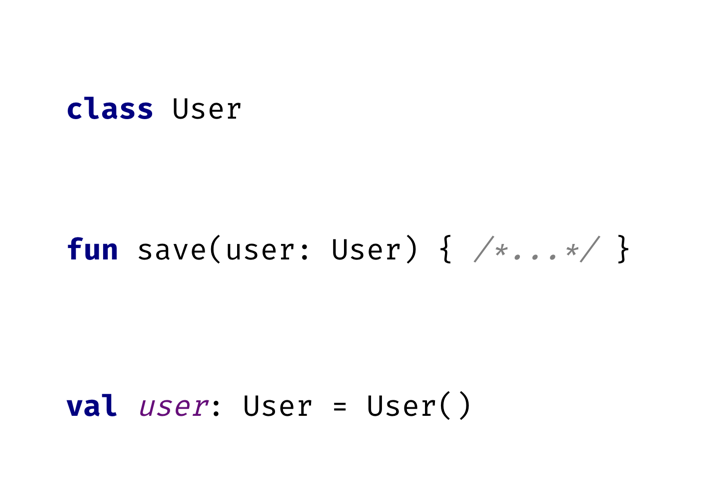
After the
class keyword, you define a class name. A class is a template for objects that defines a set of properties and methods. When we call a constructor, we create an object. Types are used here to specify what kind of objects we expect to have in the variables[^20_1].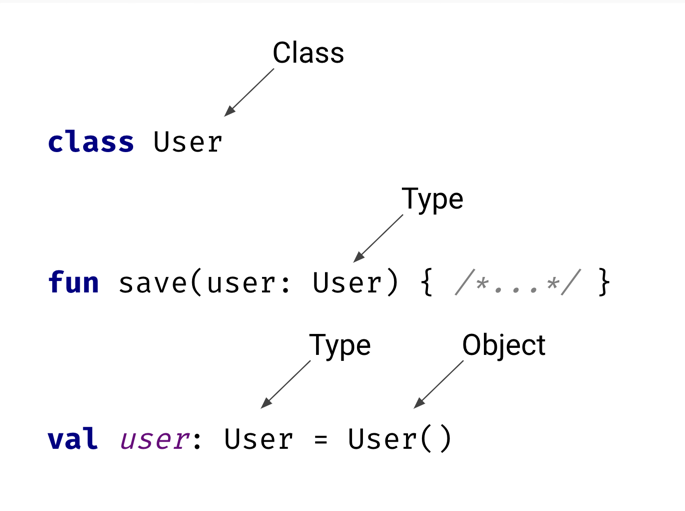
Let's do a thought experiment for a moment. Kotlin is a statically typed language, so all variables and functions must be typed. If we do not specify their types explicitly, they will be inferred. But let's take a step back and imagine that you are a language designer who is deciding what Kotlin should look like. It is possible to drop all these requirements and eliminate all types completely. The compiler does not really need them[^20_2]. It has classes that define how objects should be created, and it has objects that are used during execution. What do we lose if we get rid of types? Mostly safety and developers' convenience.
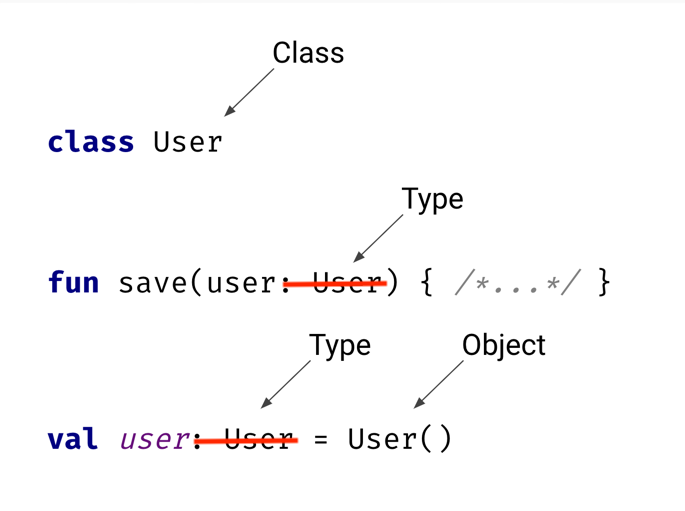
It is worth mentioning that many languages do support classes and objects but not types. Among them, there is JavaScript[^20_6] and (not long ago) Python - two of the most popular languages in the world[^20_3]. However, types do offer us value, which is why in the JavaScript community more and more people use TypeScript (which is basically JavaScript plus types), and Python has introduced support for types.
So why do we have types? They are mainly for us, developers. A type tells us what methods or properties we can use on an object. A type tells us what kind of value can be used as an argument. Types prevent the use of incorrect objects, methods, or properties. They give us safety, and suggestions are provided by the IDE. The compiler also benefits from types as they are used to better optimize our code or to decide which function should be chosen when its name is overloaded. Still, it is developers who are the most important beneficent of types.
So what is a type? It can be considered as a set of things we can do with an object. Typically, it is a set of methods and properties.
We say that classes generate types. Think of the class
User. It generates two types. Can you name them both? One is User, but the second is not Any (Any is already in the type hierarchy). The second new type generated by the class User is User?. Yes, the nullable variant is a separate type.There are classes that generate many more types: generic classes. The
Box<T> class theoretically generates an infinite number of types.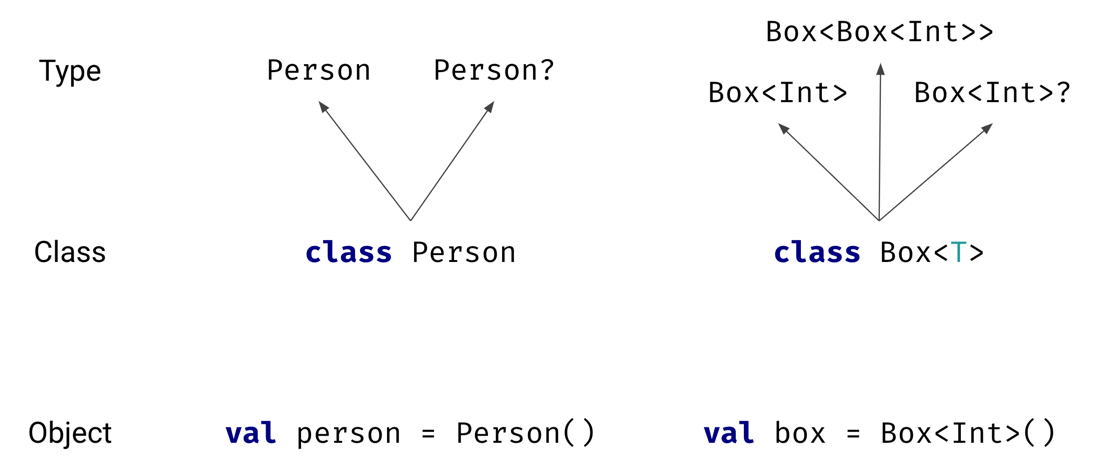
This discussion might sound very theoretical, but it already has some practical implications. Note that classes cannot be nullable, but types can. Consider the initial example, where I asked you to point out where
User is a type. Only in positions that represent types can you use User? instead of User.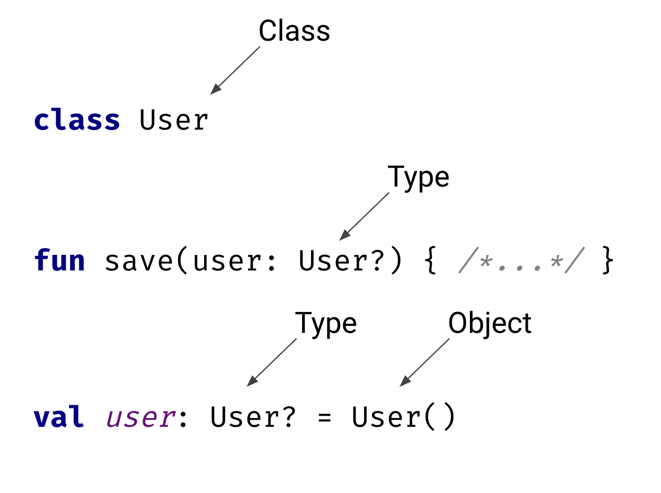
Member functions are defined on classes, so their receiver cannot be nullable or have type arguments[^20_4]. Extension functions are defined on types, so they can be nullable or defined on a concrete generic type. Consider the
sum function,, which is an extension of Iterable<Int>, or the isNullOrBlank function, which is an extension of String?.fun Iterable<Int>.sum(): Int { var sum: Int = 0 for (element in this) { sum += element } return sum } @OptIn(ExperimentalContracts::class) inline fun CharSequence?.isNullOrBlank(): Boolean { // (skipped contract definition) return this == null || this.isBlank() }
Let's say that we have a class
Dog and its superclass Animal.open class Animal class Dog : Animal()
Wherever an
Animal type is expected, you can use a Dog, but not the other way around.fun petAnimal(animal: Animal) {} fun petDog(dog: Dog) {} fun main() { val dog: Dog = Dog() val dogAnimal: Animal = dog // works petAnimal(dog) // works val animal: Animal = Animal() val animalDog: Dog = animal // compilation error petDog(animal) // compilation error }
Why? Because there is a concrete relationship between these types:
Dog is a subtype of Animal. By rule, when A is a subtype of B, we can use A where B is expected. We might also say that Animal is a supertype of Dog, and a subtype can be used where a supertype is expected.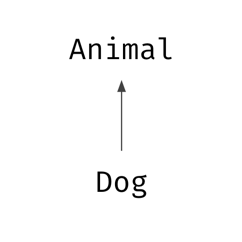
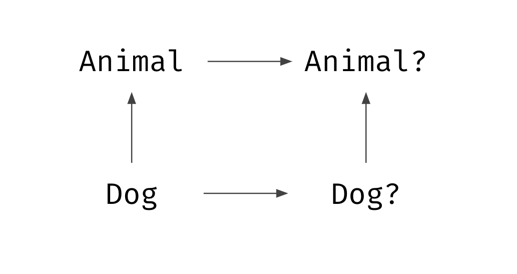
There is also a relationship between nullable and non-nullable types. A non-nullable can be used wherever a nullable is expected.
fun petDogIfPresent(dog: Dog?) {}
fun petDog(dog: Dog) {}

fun main() {
    val dog: Dog = Dog()
    val dogNullable: Dog? = dog
    petDogIfPresent(dog) // works
    petDogIfPresent(dogNullable) // works
    petDog(dog) // works
    petDog(dogNullable) // compilation error
}
This is because the non-nullable variant of each type is a subtype of the nullable variant.
The superclass of all the classes in Kotlin is
Any, which is similar to Object in Java. The supertype of all the types is not Any, it is Any?. Any is a supertype of all non-nullable types. We also have something that is not present in Java and most other mainstream languages: the subtype of all the types, which is called Nothing. We will talk about it soon.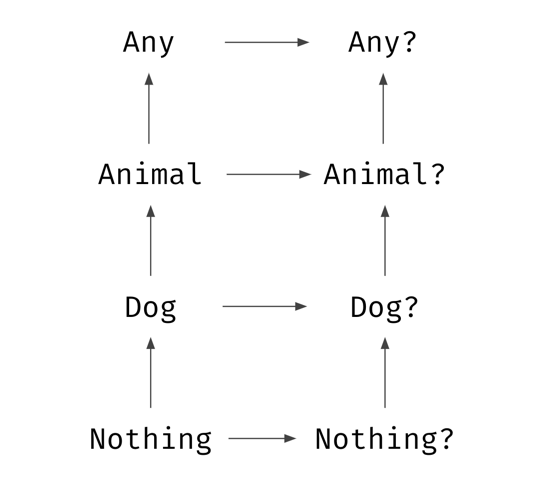
Any is only a supertype of non-nullable types. So, wherever Any is expected, nullable types will not be accepted. This fact is also used to set a type parameter’s upper boundary to accept only non-nullable types[^20_5].fun <T : Any> String.parseJson(): T = ...
Unit does not have any special place in the type hierarchy. It is just an object declaration that is used when a function does not specify a result type.object Unit { override fun toString() = "kotlin.Unit" }
Let's talk about a concept that has a very special place in the typing hierarchy: let's talk about
Nothing.Nothing is a subtype of all the types in Kotlin. If we had an instance of this type, it could be used instead of everything else (like a Joker in the card game Rummy). It’s no wonder that such an instance does not exist. Nothing is an empty type (also known as a bottom type, zero type, uninhabited type, or never type), which means it has no values. It is literally impossible to make an instance of type Nothing, but this type is still really useful. I will tell you more: some functions declare Nothing as their result type. You've likely used such functions many times already. What functions are those? They declare Nothing as a result type, but they cannot return it because this type has no instances. But what can these functions do? Three things: they either need to run forever, end the program, or throw an exception. In all cases, they never return, so the Nothing type is not only valid but also really useful.fun runForever(): Nothing { while (true) { // no-op } } fun endProgram(): Nothing { exitProcess(0) } fun fail(): Nothing { throw Error("Some error") }
I have never found a good use case for a function that runs forever, and ending a program is not very common, but we often use functions that throw exceptions. Who hasn't ever used
TODO()? This function throws a NotImplementedError exception. There is also the error function from the standard library, which throws an IllegalStateException.inline fun TODO(): Nothing = throw NotImplementedError() inline fun error(message: Any): Nothing = throw IllegalStateException(message.toString())
TODO is used as a placeholder in a place where we plan to implement some code.fun fib(n: Int): Int = TODO()
error is used to signal an illegal situation:fun get(): T = when { left != null -> left right != null -> right else -> error("Must have either left or right") }
This result type is significant. Let’s say that you have an if-condition that returns either
Int or Nothing. What should the inferred type be? The closest supertype of both Int and Nothing is Int. This is why the inferred type will be Int.// the inferred type of answer is Int val answer = if (timeHasPassed) 42 else TODO()
The same rule applies when we use the Elvis operator, a when-expression, etc. In the example below, the type of both
name and fullName is String because both fail and error declare Nothing as their result type. This is a huge convenience.fun processPerson(person: Person?) { // the inferred type of name is String val name = person?.name ?: fail() // the inferred type of fullName is String val fullName = when { !person.middleName.isNullOrBlank() -> "$name ${person.middleName} ${person.surname}" !person.surname.isNullOrBlank() -> "$name ${person.surname}" else -> error("Person must have a surname") } // ... }
I will start this subchapter with something strange: did you know that you can place
return or throw on the right side of a variable assignment?fun main() { val a = return val b = throw Error() }
This doesn’t make any sense as both
return and throw end the function, so we will never assign anything to such variables (like a and b in the example above). This assignment is an unreachable piece of code. In Kotlin, it just causes a warning.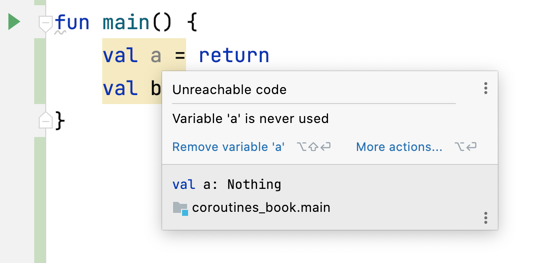
The code above is correct from the language point of view because both
return and throw are expressions, which means they declare a result type. This type is Nothing.fun main() { val a: Nothing = return val b: Nothing = throw Error() }
This explains why we can place
return or throw on the right side of the Elvis operator or in a when-expression.fun processPerson(person: Person?) { val name = person?.name ?: return val fullName = when { !person.middleName.isNullOrBlank() -> "$name ${person.middleName} ${person.surname}" !person.surname.isNullOrBlank() -> "$name ${person.surname}" else -> return } // ... }
fun processPerson(person: Person?) {
    val name = person?.name ?: throw Error("Name is required")
    val fullName = when {
        !person.middleName.isNullOrBlank() ->
            "$name ${person.middleName} ${person.surname}"
        !person.surname.isNullOrBlank() ->
            "$name ${person.surname}"
        else -> throw Error("Surname is required")
    }
    // ...
}
Both
return and throw declare Nothing as their result type. As a consequence, Kotlin will infer String as the type of both name and fullName because String is the closest supertype of both String and Nothing.So, now you can say that you know
Nothing. Just like John Snow.
When an element declares
Nothing as a return type, it means that everything after its call is not reachable. This is reasonable: there are no instances of Nothing, so it cannot be returned. This means a statement that declares Nothing as its result type will never complete in a normal way, so the next statements are not reachable. This is why everything after either fail or throw will be unreachable.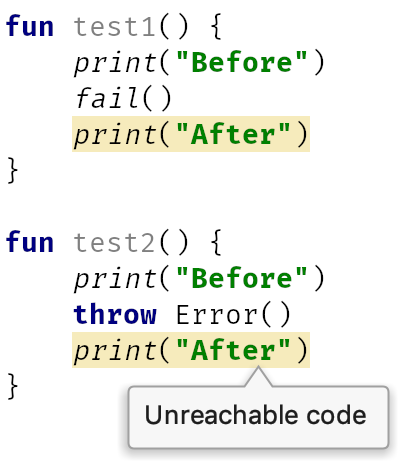
It’s the same with
return, TODO, error, etc. If a non-optional expression declares Nothing as its result type, everything after that is unreachable. This is a simple rule, but it’s useful for the compiler. It’s also useful for us since it gives us more possibilities. Thanks to this rule, we can use TODO() in a function instead of returning a value. Anything that declares Nothing as a result type ends the function (or runs forever), so this function will not end without returning or throwing first.fun fizzBuzz(): String { TODO() }
I would like to end this topic with a more advanced example that comes from the Kotlin Coroutines library. There is a
MutableStateFlow class, which represents a mutable value whose state changes can be observed using the collect method. The thing is that collect suspends the current coroutine until whatever it observes is closed, but a StateFlow cannot be closed. This is why this collect function declares Nothing as its result type.public interface SharedFlow<out T> : Flow<T> { public val replayCache: List<T> override suspend fun collect( collector: FlowCollector<T> ): Nothing }
That is very useful for developers who are not aware of how
collect works. Thanks to the result type, IntelliJ informs them that the code they place after collect is unreachable.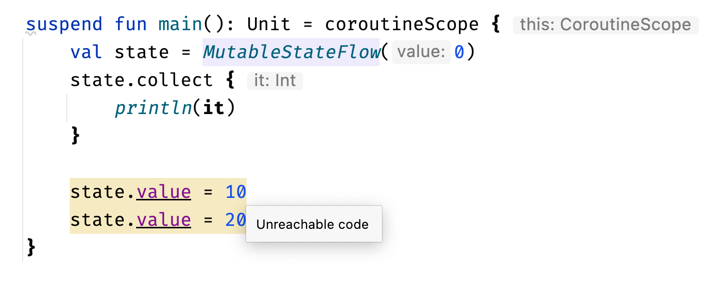
SharedFlow cannot be closed, so its
collect function will never return, therefore it declares Nothing as its result type.Let's see another peculiar thing. Did you know that you can assign
null to a variable without setting an explicit type? What’s more, such a variable can be used wherever null is accepted.fun main() { val n = null val i: Int? = n val d: Double? = n val str: String? = n }
This means that
null has its type, which is a subtype of all nullable types. Take a look at the type hierarchy and guess what type this is.I hope you guessed that the type of
null is Nothing?. Now think about the inferred type of a and b in the example below.val a = if (predicate) "A" else null val b = when { predicate2 -> "B" predicate3 -> "C" else -> null }
In the if-expression, we search for the closest supertype of the types from both branches. The closest supertype of
String and Nothing? is String?. The same is true about the when-expression: the closest supertype of String, String, and Nothing? is String?. Everything makes sense.For the same reason, whenever we require
String?, we can pass either String or null, whose type is Nothing?. This is clear when you take a look at the type hierarchy. String and Nothing? are the only non-empty subtypes of String?.
In this chapter, we've learned the following:
- A class is a template for creating objects. A type defines expectations and functionalities.
- Every class generates a nullable and a non-nullable type.
- A nullable type is a supertype of the non-nullable variant of this type.
- The supertype of all types is
Any?. - The supertype of non-nullable types is
Any. - The subtype of all types is
Nothing. - When a function declares
Nothingas a return type, this means that it will throw an error or run infinitely. - Both
throwandreturndeclareNothingas their result type. - The Kotlin compiler understands that when an expression declares
Nothingas a result type, everything after that is unreachable. - The type of
nullisNothing?, which is the subtype of all nullable types.
In the next chapter, we are going to discuss generics, and we’ll see how they are important for our type system.
[^20_1]: Parameters are also variables.
[^20_2]: Except when figuring out which function to choose in the case of overloading.
[^20_3]: It all depends on what we measure, but Python, Java, and JavaScript take the first three positions in most rankings. In some, they are beaten by C, which is widely used for very low-level development, like developing processors for cars or refrigerators.
[^20_4]: Type arguments and type parameters will be better explained in the chapter Generics.
[^20_5]: I will explain type parameters' upper boundaries in the chapter Generics.
[^20_6]: Formally, JavaScript supports weak typing, but in this chapter we discuss static typing, which is not supported by JavaScript.
[^20_2]: Except when figuring out which function to choose in the case of overloading.
[^20_3]: It all depends on what we measure, but Python, Java, and JavaScript take the first three positions in most rankings. In some, they are beaten by C, which is widely used for very low-level development, like developing processors for cars or refrigerators.
[^20_4]: Type arguments and type parameters will be better explained in the chapter Generics.
[^20_5]: I will explain type parameters' upper boundaries in the chapter Generics.
[^20_6]: Formally, JavaScript supports weak typing, but in this chapter we discuss static typing, which is not supported by JavaScript.