
This is a chapter from the book Kotlin Essentials. You can find it on LeanPub or Amazon. It is also available as a course.
Every language needs a convenient way to represent basic kinds of values, like numbers or characters. All languages need to have built-in types and literals. Types are used to represent certain types of values. Some type examples are
Int, Boolean, or String. Literals are built-in notations that are used to create instances. Some literal examples are a string literal, which is text in quotation marks, or an integer literal, which is a bare number.In this chapter, we’ll learn about the basic Kotlin types and their literals:
- numbers (
Int,Long,Double,Float,Short,Byte), - booleans (
Boolean), - characters (
Char), - strings (
String).
There is also the array primitive type in Kotlin, which will be covered in the chapter Collections.
In Kotlin, all values are considered objects (there are no primitive types), so they all have methods, and their types can be used as generic type arguments (this will be covered later). Types that represent numbers, booleans, and characters might be optimized by the Kotlin compiler and used as primitives, but this optimization does not affect Kotlin developers, therefore you don’t need to even think about it.
Let's start discussing the basic types in Kotlin, one by one.
In Kotlin, there is a range of different types that are used to represent numbers. They can be divided into those representing integer numbers (without decimal points) and those representing floating-point numbers (with decimal points). In these groups, the difference is in the number of bits used to represent these numbers, which determines the possible number size and precision.
To represent integer numbers, we use
Int, Long, Byte, and Short.| Type | Size (bits) | Min value | Max value |
|---------|-------------|------------|---------------|
|
|
|
|
|---------|-------------|------------|---------------|
|
Byte | 8 | -128 | 127 ||
Short | 16 | -32768 | 32767 ||
Int | 32 | $-2^{31}$ | $2^{31} - 1$ ||
Long | 64 | $-2^{63}$ | $2^{63} - 1$ |To represent floating-point numbers, we use
Float and Double.| Type | Size (bits) | Significant bits | Exponent bits | Decimal digits |
|----------|-------------|------------------|---------------|----------------|
|
|
|----------|-------------|------------------|---------------|----------------|
|
Float | 32 | 24 | 8 | 6-7 ||
Double | 64 | 53 | 11 | 15-16 |A plain number without a decimal point is interpreted as an
Int. A plain number with a decimal point is interpreted as a Double.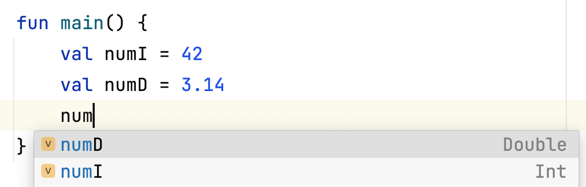
You can create
Long by using the L suffix after the number. Long is also used for number literals that are too big for Int.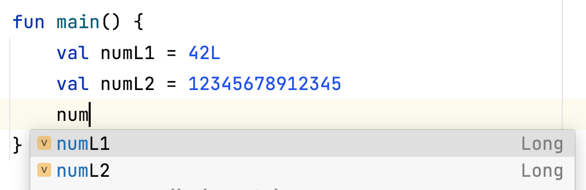
Similarly, you can create a
Float by ending a number with the F or f suffix.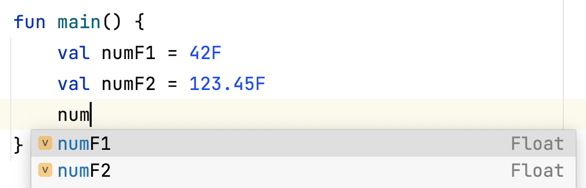
There is no suffix to create
Byte or Short types. However, a number explicitly typed as one of these types will create an instance of this type. This also works for Long.fun main() { val b: Byte = 123 val s: Short = 345 val l: Long = 345 }
This is not a conversion! Kotlin does not support implicit type conversion, so you cannot use
Byte or Long where Int is expected.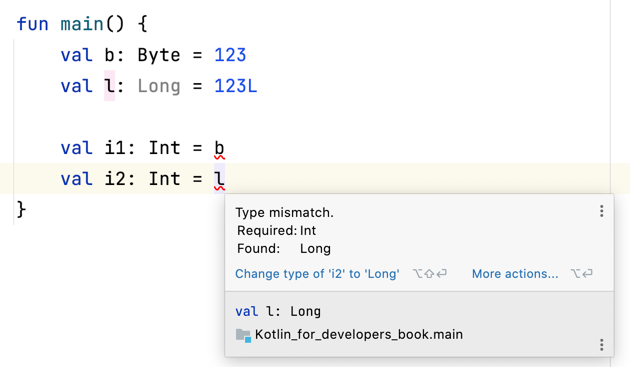
If we need to explicitly convert one number to another type, we use explicit conversion functions like
toInt or toLong.fun main() { val b: Byte = 123 val l: Long = 123L val i: Int = 123 val i1: Int = b.toInt() val i2: Int = l.toInt() val l1: Long = b.toLong() val l2: Long = i.toLong() }
In number literals, we can use the underscore
_ between digits. This character is ignored, but we sometimes use it to format long numbers for better readability.fun main() { val million = 1_000_000 println(million) // 1000000 }
To define a number using the hexadecimal numeral system, start it with
0x. To define a number using the binary numeral system, start it with 0b. The octal numeral system is not supported.fun main() { val hexBytes = 0xA4_D6_FE_FE println(hexBytes) // 2765553406 val bytes = 0b01010010_01101101_11101000_10010010 println(bytes) // 1382934674 }
All basic types that represent numbers are a subtype of the
Number type.fun main() { val i: Int = 123 val b: Byte = 123 val l: Long = 123L val n1: Number = i val n2: Number = b val n3: Number = l }
The
Number type specifies transformation functions: from the current number to any other basic type representing a number.abstract class Number { abstract fun toDouble(): Double abstract fun toFloat(): Float abstract fun toLong(): Long abstract fun toInt(): Int abstract fun toChar(): Char abstract fun toShort(): Short abstract fun toByte(): Byte }
This means that for each basic number you can transform it into a different basic number using the
to{new type} function. Such functions are known as conversion functions.fun main() { val b: Byte = 123 val l: Long = b.toLong() val f: Float = l.toFloat() val i: Int = f.toInt() val d: Double = i.toDouble() println(d) // 123.0 }
Numbers in Kotlin support the basic mathematical operations:
- addition (
+), - subtraction (
-), - multiplication (
*), - division (
/).
fun main() {
    val i1 = 12
    val i2 = 34
    println(i1 + i2) // 46
    println(i1 - i2) // -22
    println(i1 * i2) // 408
    println(i1 / i2) // 0

    val d1 = 1.4
    val d2 = 2.5
    println(d1 + d2) // 3.9
    println(d1 - d2) // -1.1
    println(d1 * d2) // 3.5
    println(d1 / d2) // 0.5599999999999999
}
Notice, that the correct result of1.4 / 2.5should be0.56, not0.5599999999999999. This problem will be addressed soon.
Beware that when we divide an
Int by an Int, the result is also Int, so the decimal part is lost.fun main() { println(5 / 2) // 2, not 2.5 }
The solution is first to convert an integer into a floating-point representation and then divide it.
fun main() {
    println(5.toDouble() / 2) // 2.5
}
There is also a remainder operator[^04_2]
%:fun main() { println(1 % 3) // 1 println(2 % 3) // 2 println(3 % 3) // 0 println(4 % 3) // 1 println(5 % 3) // 2 println(6 % 3) // 0 println(7 % 3) // 1 println(0 % 3) // 0 println(-1 % 3) // -1 println(-2 % 3) // -2 println(-3 % 3) // 0 }
Kotlin also supports operations that modify a read-write variable
var:+=, wherea += bis the equivalent ofa = a + b,-=, wherea -= bis the equivalent ofa = a - b,*=, wherea *= bis the equivalent ofa = a * b,/=, wherea /= bis the equivalent ofa = a / b,%=, wherea %= bis the equivalent ofa = a % b,- post-incrementation and pre-incrementation
++, which increment variables value by1, - post-decrementation and pre-decrementation
--, which decrement variables value by1.
fun main() {
    var i = 1
    println(i) // 1
    i += 10
    println(i) // 11
    i -= 5
    println(i) // 6
    i *= 3
    println(i) // 18
    i /= 2
    println(i) // 9
    i %= 4
    println(i) // 1

    // Post-incrementation
    // increments value and returns the previous value
    println(i++) // 1
    println(i) // 2

    // Pre-incrementation
    // increments value and returns the new value
    println(++i) // 3
    println(i) // 3

    // Post-decrementation
    // decrements value and returns the previous value
    println(i--) // 3
    println(i) // 2

    // Pre-decrementation
    // decrements value and returns the new value
    println(--i) // 1
    println(i) // 1
}
Kotlin also supports operations on bits using the following methods, which can be called using the infix notation (so, between two values):
andkeeps only bits that have1in the same binary positions in both numbers.orkeeps only bits that have1in the same binary positions in one or both numbers.xorkeeps only bits that have exactly one1in the same binary positions in both numbers.shlshifts the left value left by the right number of bits.shrshifts the left value right by the right number of bits, filling the leftmost bits with copies of the sign bit.ushrshifts the left value right by the right number of bits, filling the leftmost bits with zeros.
fun main() {
    println(0b0101 and 0b0001) // 1, that is 0b0001
    println(0b0101 or 0b0001)  // 5, that is 0b0101
    println(0b0101 xor 0b0001) // 4, that is 0b0100
    println(0b0101 shl 1) // 10, that is 0b1010
    println(0b0101 shr 1) // 2,  that is 0b0010
    println(0b0101 ushr 1) // 2,  that is 0b0010
}
All basic types in Kotlin have limited size and precision, which can lead to imprecise or incorrect results in some situations.
fun main() {
    println(0.1 + 0.2) // 0.30000000000000004
    println(2147483647 + 1) // -2147483648
}
This is a standard tradeoff in programming, and in most cases we just need to accept it. However, there are cases where we need to have perfect precision and unlimited number size. On JVM, for unlimited number size we should use
BigInteger, which represents a number without a decimal part. For unlimited size and precision, we should use the BigDecimal, which represents a number that has a decimal part. Both can be created using constructors[^04_1], factory functions (like valueOf), or a conversion from basic types that represent numbers (toBigDecimal and toBigInteger methods).import java.math.BigDecimal import java.math.BigInteger fun main() { val i = 10 val l = 10L val d = 10.0 val f = 10.0F val bd1: BigDecimal = BigDecimal(123) val bd2: BigDecimal = BigDecimal("123.00") val bd3: BigDecimal = i.toBigDecimal() val bd4: BigDecimal = l.toBigDecimal() val bd5: BigDecimal = d.toBigDecimal() val bd6: BigDecimal = f.toBigDecimal() val bi1: BigInteger = BigInteger.valueOf(123) val bi2: BigInteger = BigInteger("123") val bi3: BigInteger = i.toBigInteger() val bi4: BigInteger = l.toBigInteger() }
BigDecimal and BigInteger also support basic mathematical operators:import java.math.BigDecimal import java.math.BigInteger fun main() { val bd1 = BigDecimal("1.2") val bd2 = BigDecimal("3.4") println(bd1 + bd2) // 4.6 println(bd1 - bd2) // -2.2 println(bd1 * bd2) // 4.08 println(bd1 / bd2) // 0.4 val bi1 = BigInteger("12") val bi2 = BigInteger("34") println(bi1 + bi2) // 46 println(bi1 - bi2) // -22 println(bi1 * bi2) // 408 println(bi1 / bi2) // 0 }
On platforms other than Kotlin/JVM, external libraries are needed to represent numbers with unlimited size and precision.
Another basic type is
Boolean, which has two possible values: true and false.fun main() { val b1: Boolean = true println(b1) // true val b2: Boolean = false println(b2) // false }
We use booleans to express yes/no answers, like:
- Is the user an admin?
- Has the user accepted the cookies policy?
- Are two numbers identical?
In practice, booleans are often a result of some kind of comparison.
A
Boolean is often a result of equality comparison. In Kotlin, we compare two objects for equality using the double equality sign ==. To check if two objects are not equal, we use the non-equality sign !=.fun main() { println(10 == 10) // true println(10 == 11) // false println(10 != 10) // false println(10 != 11) // true }
Numbers and all objects that are comparable (i.e., they implement the
Comparable interface) can also be compared with >, <, >=, and <=.fun main() { println(10 > 10) // false println(10 > 11) // false println(11 > 10) // true println(10 < 10) // false println(10 < 11) // true println(11 < 10) // false println(10 >= 10) // true println(10 >= 11) // false println(11 >= 10) // true println(10 <= 10) // true println(10 <= 11) // true println(11 <= 10) // false }
There are three basic logical operators in Kotlin:
- and
&&, which returnstruewhen the value on both its sides istrue; otherwise, it returnsfalse. - or
||, which returnstruewhen the value on either of its sides istrue; otherwise, it returnsfalse. - not
!, which turnstrueintofalse, andfalseintotrue.
fun main() {
    println(true && true) // true
    println(true && false) // false
    println(false && true) // false
    println(false && false) // false

    println(true || true) // true
    println(true || false) // true
    println(false || true) // true
    println(false || false) // false

    println(!true) // false
    println(!false) // true
}
Kotlin does not support any kind of automatic conversion to
Boolean (or any other type), so logical operators should be used only with objects of type Boolean.To represent a single character, we use the
Char type. We specify a character using apostrophes.fun main() { println('A') // A println('Z') // Z }
Each character is represented as a Unicode number. To find out the Unicode of a character, use the
code property.fun main() { println('A'.code) // 65 }
Kotlin accepts Unicode characters. To describe them by their code, we start with
\u, and then we need to use hexadecimal format, just like in Java.fun main() { println('\u00A3') // £ }
Strings are just sequences of characters that form a piece of text. In Kotlin, we create a string using quotation marks
" or triple quotation marks """.fun main() { val text1 = "ABC" println(text1) // ABC val text2 = """DEF""" println(text2) // DEF }
A string wrapped in single quotation marks requires text in a single line. If we want to define a newline character, we need to use a special character
\n. This is not the only thing that needs (or might need) a backslash to be expressed in a string.| Escape Sequence | Meaning |
|-----------------|-----------------------|
|
|
|
|
|
|
|
|
|
|-----------------|-----------------------|
|
\t | Tab ||
\b | Backspace ||
\r | Carriage return ||
\f | Form feed ||
\n | Newline ||
\' | Single quotation mark ||
\" | Quotation mark ||
\\ | Backslash ||
\$ | Dollar |Strings in triple quotation marks can be multiline; in these strings, special characters can be used directly, and forms prefixed by a backslash don’t work.
fun main() {
    val text1 = "Let\'s say:\n\"Hooray\""
    println(text1)
    // Let's say:
    // "Hooray"
    val text2 = """Let\'s say:\n\"Hooray\""""
    println(text2)
    // Let\'s say:\n\"Hooray\"
    val text3 = """Let's say:
"Hooray""""
    println(text3)
    // Let's say:
    // "Hooray"
}
To better format triple quotation mark strings, we use the
trimIndent function, which ignores a constant number of spaces for each line.fun main() { val text = """ Let's say: "Hooray" """.trimIndent() println(text) // Let's say: // "Hooray" val description = """ A B C """.trimIndent() println(description) // A // B // C }
String literals may contain template expressions, which are pieces of code that are evaluated and whose results are concatenated into a string. A template expression starts with a dollar sign (
$) and consists of either a variable name (like "text is $text") or an expression in curly braces (like "1 + 2 = ${1 + 2}").fun main() { val name = "Cookie" val surname = "DePies" val age = 6 val fullName = "$name $surname ($age)" println(fullName) // Cookie DePies (6) val fullNameUpper = "${name.uppercase()} ${surname.uppercase()} ($age)" println(fullNameUpper) // COOKIE DEPIES (6) val description = """ Name: $name Surname: $surname Age: $age """.trimIndent() println(description) // Name: Cookie // Surname: DePies // Age: 6 }
If you need to use a special character inside a triple quotation mark string, the easiest way is to specify it with a regular string and include it using template syntax.
fun main() {
    val text1 = """ABC\nDEF"""
    println(text1) // ABC\nDEF
    val text2 = """ABC${"\n"}DEF"""
    println(text2)
    // ABC
    // DEF
}
In Kotlin strings, we use Unicode, so we can also define a Unicode character using a number that starts with
\u, and then specifying a Unicode character code in hexadecimal syntax.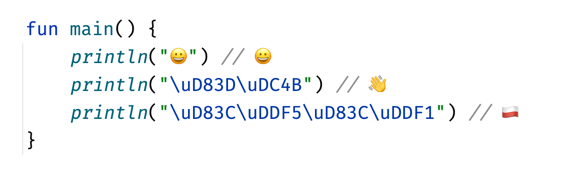
You can use
+ operator to concatenate two strings, so to create a new string that is a combination of two other strings. You can also use this operator to concatenate a string with any other object, which will be converted to a string. The result is always a string.fun main() { val text1 = "ABC" val text2 = "DEF" println(text1 + text2) // ABCDEF println(text1 + 123) // ABC123 println(text1 + true) // ABCtrue }
In this chapter, we've learned about the basic Kotlin types and the literals we use to create them:
- Numbers that are represented by types
Int,Long,Double,Float,Short, andByteare created with bare number values with possible suffixes for type customization. We can define negative numbers or decimal parts. We can also use underscores for nicer number formatting. - Boolean values
trueandfalseare represented by theBooleantype. - Characters, which are represented by the
Chartype. We define a character value using single quotation marks. - Strings, which are used to represent text, are represented by the
Stringtype. Each string is just a series of characters. We define strings inside double quotation marks.
So, we have the foundations for using Kotlin. Let's move on to more-complicated control structures that determine how our code behaves.
[^04_1]: Constructors will be covered in the chapter Classes.
[^04_2]: This operator is similar to modulo. Both the remainder and the modulo operations act the same for positive numbers but differently for negative numbers. The result of -5 remainder 4 is -1 because -5 = 4 * (-1) + (-1). The result of -5 modulo 4 is 3 because -5 = 4 * (-2) + 3.
[^04_2]: This operator is similar to modulo. Both the remainder and the modulo operations act the same for positive numbers but differently for negative numbers. The result of -5 remainder 4 is -1 because -5 = 4 * (-1) + (-1). The result of -5 modulo 4 is 3 because -5 = 4 * (-2) + 3.